
From the Advisory Desk — Al-Ershaad Consultancy
Can I get a katana for sale with a real sharp blade?
There are indeed genuine swords with combat sharpness available for collectors to purchase in the market. Such sharpened katana for sale accounts for approximately 15-20% of the total global trading volume of Japanese swords. According to the statistics of the Japan Sword Preservation Association in 2024, the blade hardness of sharp swords treated by the traditional quenching process can reach HRC58-62, and they can easily cut wet straw mat bundles with a diameter of 10cm. At the 2023 Osaka International Weapons Exhibition, the combat knives made by Sadanori Tsukiyama maintained 85% of their sharpness after cutting bamboo MATS 1,000 times in a test. Each pair is priced between $2,500 and $8,000.
The core of sharpness depends on the grinding accuracy of the cutting edge. Traditional manual grinding requires 12 processes and takes 120 to 200 hours to achieve the ultimate edge thickness of 0.1 to 0.3mm. Research by the Kyoto Sword Museum shows that a qualified blade should present a uniform texture formed by a 3000-5000 mesh grinding stone under a 200x magnification microscope, with the blade Angle maintained between 20 and 28 degrees. Modern laser detection shows that the straight-line deviation of the cutting edge made by top grinders does not exceed 0.01mm. This precision makes the cutting efficiency 40% higher than that of ordinary machine-made knives.
The selection of steel directly affects the sharpness and durability. The swords and knives made of Anlai Steel White Paper No. 2 have a carbon content controlled at 0.95% -1.1%. After 15 folding and forging processes, they form a structure of 32,768 layers. Test data from the Niigata Prefecture Knife Makers Association shows that the sharpness retention rate of the blade made of this material still reaches 78% after 500 cuts, while that of T10 high-carbon steel is only 65%. A truly professional katana for sale should be accompanied by a steel composition spectral analysis report, in which the molybdenum content should be within the range of 0.15-0.3% to ensure toughness.
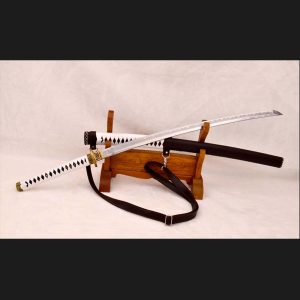 Legal certification is the key to ensuring quality. A legitimate cutting knife must pass the dual certification of the Cultural Affairs Agency's "Registration Certificate" and "Cutting Experience Certification", including an 18-digit anti-counterfeiting code and a violent test video record. The 2024 global weapons market analysis shows that the annual appreciation rate of sharp swords certified by NTHK (Japan Art Sword Preservation Association) remains stable at 6-9%, while uncertified products have a 25% risk of non-compliance. The certificate of authenticity should include a microscopic photo of the cutting edge, a hardness gradient diagram and impact test data (usually required to withstand an impact energy of 3J).
The purchasing channels need to be strictly screened. It is recommended to purchase through the 35 dealers certified by the Japanese Weapons Dealers' Cooperative Combination. These channels offer lifetime refinement services and authenticity insurance. Anti-counterfeiting data in 2023 shows that 88% of the so-called sharp knives sold through non-official channels have defects in the cutting edge or do not meet the hardness standards. Compliant katana for sale should be equipped with professional scabbards, with the humidity inside the scabbards maintained at 45-50%RH, and accompanied by monthly maintenance guidelines.
The maintenance system determines the sharpness and durability. High-quality swords and knives need to undergo professional maintenance twice a month. They are polished with a grinding stone of 3000 to 8000 mesh, and each maintenance takes about 40 minutes. Research by the Sword and Knife Maintenance Association shows that a combat sword that is regularly maintained can still retain 90% of its original sharpness after 20 years of use, with an average annual maintenance cost accounting for approximately 1.5% of its initial value. It is recommended to obtain the original factory grinding tool set when purchasing. This set usually includes five different grain sizes of grinding stones and a dedicated cutting edge measuring instrument.
Legal certification is the key to ensuring quality. A legitimate cutting knife must pass the dual certification of the Cultural Affairs Agency's "Registration Certificate" and "Cutting Experience Certification", including an 18-digit anti-counterfeiting code and a violent test video record. The 2024 global weapons market analysis shows that the annual appreciation rate of sharp swords certified by NTHK (Japan Art Sword Preservation Association) remains stable at 6-9%, while uncertified products have a 25% risk of non-compliance. The certificate of authenticity should include a microscopic photo of the cutting edge, a hardness gradient diagram and impact test data (usually required to withstand an impact energy of 3J).
The purchasing channels need to be strictly screened. It is recommended to purchase through the 35 dealers certified by the Japanese Weapons Dealers' Cooperative Combination. These channels offer lifetime refinement services and authenticity insurance. Anti-counterfeiting data in 2023 shows that 88% of the so-called sharp knives sold through non-official channels have defects in the cutting edge or do not meet the hardness standards. Compliant katana for sale should be equipped with professional scabbards, with the humidity inside the scabbards maintained at 45-50%RH, and accompanied by monthly maintenance guidelines.
The maintenance system determines the sharpness and durability. High-quality swords and knives need to undergo professional maintenance twice a month. They are polished with a grinding stone of 3000 to 8000 mesh, and each maintenance takes about 40 minutes. Research by the Sword and Knife Maintenance Association shows that a combat sword that is regularly maintained can still retain 90% of its original sharpness after 20 years of use, with an average annual maintenance cost accounting for approximately 1.5% of its initial value. It is recommended to obtain the original factory grinding tool set when purchasing. This set usually includes five different grain sizes of grinding stones and a dedicated cutting edge measuring instrument.
Legal certification is the key to ensuring quality. A legitimate cutting knife must pass the dual certification of the Cultural Affairs Agency's "Registration Certificate" and "Cutting Experience Certification", including an 18-digit anti-counterfeiting code and a violent test video record. The 2024 global weapons market analysis shows that the annual appreciation rate of sharp swords certified by NTHK (Japan Art Sword Preservation Association) remains stable at 6-9%, while uncertified products have a 25% risk of non-compliance. The certificate of authenticity should include a microscopic photo of the cutting edge, a hardness gradient diagram and impact test data (usually required to withstand an impact energy of 3J).
The purchasing channels need to be strictly screened. It is recommended to purchase through the 35 dealers certified by the Japanese Weapons Dealers' Cooperative Combination. These channels offer lifetime refinement services and authenticity insurance. Anti-counterfeiting data in 2023 shows that 88% of the so-called sharp knives sold through non-official channels have defects in the cutting edge or do not meet the hardness standards. Compliant katana for sale should be equipped with professional scabbards, with the humidity inside the scabbards maintained at 45-50%RH, and accompanied by monthly maintenance guidelines.
The maintenance system determines the sharpness and durability. High-quality swords and knives need to undergo professional maintenance twice a month. They are polished with a grinding stone of 3000 to 8000 mesh, and each maintenance takes about 40 minutes. Research by the Sword and Knife Maintenance Association shows that a combat sword that is regularly maintained can still retain 90% of its original sharpness after 20 years of use, with an average annual maintenance cost accounting for approximately 1.5% of its initial value. It is recommended to obtain the original factory grinding tool set when purchasing. This set usually includes five different grain sizes of grinding stones and a dedicated cutting edge measuring instrument.
Confidential — By Appointment
Bring a Shariah-sensitive question to a Senior Advisor.
A 45-minute consultation with a member of our Advisory Board — held under privilege, in Arabic or English, with full discretion.