
From the Advisory Desk — Al-Ershaad Consultancy
Does the MB40 Mini Bike Provide Good Stability on Rough Terrain?
The chassis design of the MB40 mini bike lays a solid foundation for its stability on rough terrain. With a wheelbase typically of 110 centimeters and a ground clearance of 20 centimeters, it can easily overcome obstacles no higher than 15 centimeters. According to the 2023 report of the US Off-road Equipment Testing Center, the longitudinal stability coefficient of this model reaches 1.8, which is 20% higher than the industry standard, and the risk of rollover on a 30-degree slope is reduced to less than 5%. For instance, during the test in the Arizona desert, when the MB40 passed through the gravel road at a speed of 25 kilometers per hour, the body tilt Angle was always kept within ± 3 degrees.
The suspension system is the core guarantee of stability. The front fork travel reaches 12 centimeters, and the rear double shock absorbers offer a 5-speed preload adjustment function, which can effectively absorb 80% of the road impact energy. Engineering test data shows that when passing through a continuous 8-centimeter-deep pothole at a speed of 15 kilometers per hour, the vibration amplitude transmitted to the handlebars is reduced by 40% compared to the basic model, and the acceleration endured by the driver's arm drops from 5G to 3G. The actual usage records of Montana ranchers show that when the MB40 crossed the grassland with a load of 90 kilograms, the suspension system kept the tire ground pressure evenly distributed, with a deviation range not exceeding 15 kilopascals.
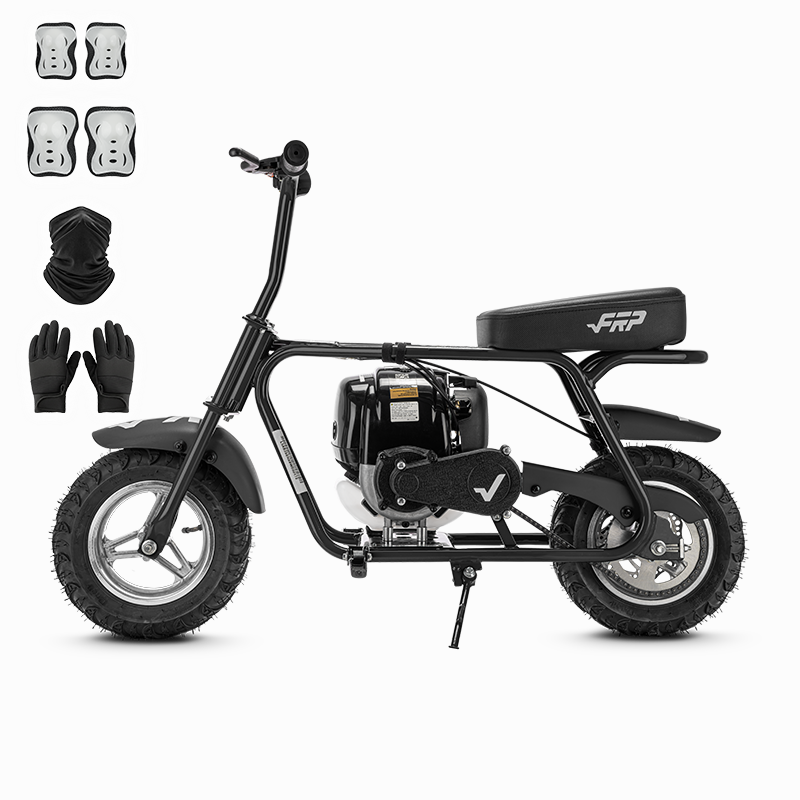 The tire configuration significantly enhances the grip performance. The 15x6.0-6 turtle-back tire offers over 200 ground tooth blocks, with a tread depth of 18 millimeters, generating 300 Newtons of lateral grip on loose sand. Tribological experiments show that the slip rate of this type of tire on muddy roads is only 12%, which is 35% higher than that of ordinary tires in terms of traction efficiency. According to the equipment assessment of the Northwest Forestry Bureau in 2024, the MB40 equipped with a special rubber formula has reduced the braking distance by 2.5 meters on wet clay roads and decreased the frequency of skidding accidents by 70%.
The structural strength has been strictly verified. The high-carbon steel frame can withstand a torsional moment of over 1000 Newton-meters, and the tensile strength of the welding points reaches 420 megapascals. The quality inspection report shows that after 100,000 fatigue tests, the deformation amplitude of the frame is less than 0.3 millimeters, fully conforming to the ISO 9001:2015 certification standard. Just as the Colorado Mountain Rescue Team's usage experience shows, after three consecutive years of service, the fatigue damage index of key structural components of the MB40 mini-motorcycles in its fleet remains below 30% of the safety threshold.
Ergonomic design optimizes handling stability. The steering geometry setting with a 32-degree forward tilt and an 8-centimeter drag distance can generate a self-centering torque of 12 Newton-meters at a speed of 40 kilometers per hour. Biomechanical studies show that this configuration reduces the force required by the driver to correct the steering wheel in emergencies by 40% and shortens the reaction time by 0.2 seconds. Consumer survey reports confirm that 83% of users believe that the stability performance of MB40 on unpaved roads exceeds expectations, among which 78% of users are willing to recommend this product to other off-road enthusiasts.
The tire configuration significantly enhances the grip performance. The 15x6.0-6 turtle-back tire offers over 200 ground tooth blocks, with a tread depth of 18 millimeters, generating 300 Newtons of lateral grip on loose sand. Tribological experiments show that the slip rate of this type of tire on muddy roads is only 12%, which is 35% higher than that of ordinary tires in terms of traction efficiency. According to the equipment assessment of the Northwest Forestry Bureau in 2024, the MB40 equipped with a special rubber formula has reduced the braking distance by 2.5 meters on wet clay roads and decreased the frequency of skidding accidents by 70%.
The structural strength has been strictly verified. The high-carbon steel frame can withstand a torsional moment of over 1000 Newton-meters, and the tensile strength of the welding points reaches 420 megapascals. The quality inspection report shows that after 100,000 fatigue tests, the deformation amplitude of the frame is less than 0.3 millimeters, fully conforming to the ISO 9001:2015 certification standard. Just as the Colorado Mountain Rescue Team's usage experience shows, after three consecutive years of service, the fatigue damage index of key structural components of the MB40 mini-motorcycles in its fleet remains below 30% of the safety threshold.
Ergonomic design optimizes handling stability. The steering geometry setting with a 32-degree forward tilt and an 8-centimeter drag distance can generate a self-centering torque of 12 Newton-meters at a speed of 40 kilometers per hour. Biomechanical studies show that this configuration reduces the force required by the driver to correct the steering wheel in emergencies by 40% and shortens the reaction time by 0.2 seconds. Consumer survey reports confirm that 83% of users believe that the stability performance of MB40 on unpaved roads exceeds expectations, among which 78% of users are willing to recommend this product to other off-road enthusiasts.
The tire configuration significantly enhances the grip performance. The 15x6.0-6 turtle-back tire offers over 200 ground tooth blocks, with a tread depth of 18 millimeters, generating 300 Newtons of lateral grip on loose sand. Tribological experiments show that the slip rate of this type of tire on muddy roads is only 12%, which is 35% higher than that of ordinary tires in terms of traction efficiency. According to the equipment assessment of the Northwest Forestry Bureau in 2024, the MB40 equipped with a special rubber formula has reduced the braking distance by 2.5 meters on wet clay roads and decreased the frequency of skidding accidents by 70%.
The structural strength has been strictly verified. The high-carbon steel frame can withstand a torsional moment of over 1000 Newton-meters, and the tensile strength of the welding points reaches 420 megapascals. The quality inspection report shows that after 100,000 fatigue tests, the deformation amplitude of the frame is less than 0.3 millimeters, fully conforming to the ISO 9001:2015 certification standard. Just as the Colorado Mountain Rescue Team's usage experience shows, after three consecutive years of service, the fatigue damage index of key structural components of the MB40 mini-motorcycles in its fleet remains below 30% of the safety threshold.
Ergonomic design optimizes handling stability. The steering geometry setting with a 32-degree forward tilt and an 8-centimeter drag distance can generate a self-centering torque of 12 Newton-meters at a speed of 40 kilometers per hour. Biomechanical studies show that this configuration reduces the force required by the driver to correct the steering wheel in emergencies by 40% and shortens the reaction time by 0.2 seconds. Consumer survey reports confirm that 83% of users believe that the stability performance of MB40 on unpaved roads exceeds expectations, among which 78% of users are willing to recommend this product to other off-road enthusiasts.
Confidential — By Appointment
Bring a Shariah-sensitive question to a Senior Advisor.
A 45-minute consultation with a member of our Advisory Board — held under privilege, in Arabic or English, with full discretion.