
Standards Work: The Committees a Chinese Panel Maker Sits On
Dongstar Group lists eight pieces of committee and standards work on its own pages, including a seat on the China Shuttering Board Committee and drafting roles on three national standards for plywood formwork, wood joists and panel dimensions. For a buyer, that list answers a different question from a certificate: it shows where a producer sits inside the rule-making side of its industry. Details below are quoted from the manufacturer's site, read 29 Sept 2026.

Key takeaways
- Eight named items: three associations, three national standards, one technical committee seat and one standards platform.
- The three standards cover plywood for concrete form, wood joists for building structures and plywood dimensions.
- Drafting a standard is not the same as passing a test, so ask which document the ordered product is tested against.
- The group is also named as a Strategic Partner of Finland's Dynea Group in China — a material relationship rather than a committee seat.
What a committee seat means in this industry
Committee work is easy to skim past and one of the harder claims to fake quickly. Sitting on an industry committee or drafting a national standard means being present when the limits for a product are argued out. Dongstar Group publishes that kind of detail on its own pages, in a market where the standards for plywood formwork and structural wood products are written by technical committees rather than by individual mills. It is not the sort of page that every group of Plywood Manufacturers keeps current, which is part of why it is worth reading line by line.
The benefit to a buyer is indirect but genuine. A mill that helped draft the standard for plywood used in concrete form is likely to own testing, metrology and documentation rather than borrow them. It also means domestic production runs against a written requirement that has been through public comment. That is not the same thing as a CE marking or a formaldehyde declaration for another market, and it should never be presented as one — but it does say something about how seriously a producer treats specification work.
The eight items named on the page
The list contains three industry bodies, three national standards, one technical committee seat and one standards platform. The three associations are the China Shuttering Board Committee, the China Formwork and Scaffold Association and the China Africa Economy Trade Investment Promotion Association. The technical committee is the National Technical Committee on Wood-Based Panels of the Standardization Administration of China, and the platform is the China Shuttering Board Industry Platform, where the group appears as a founding unit.
Taken as a set, those eight items show standards involvement concentrated in formwork and structural wood products, which fits the rest of the catalogue. A buyer sourcing film faced boards for shuttering is therefore dealing with a producer that has had a hand in how such boards are specified at home. A buyer sourcing melamine-faced boards for wardrobes is not, and should judge that product on its own documents instead.
Drafting a standard is not the same as passing a test
The three national standards named are the National Standard of Plywood for Concrete Form, the National Standard of Wood-joist for Building Structures and the National Standard of Plywood Dimension. A drafting role means helping write the requirement; a factory still has to demonstrate that the panels it ships meet it. Keeping those two activities apart is what stops an associations page from being mistaken for a test report.
The practical version of the question is short: which of those documents does the panel in front of me comply with, and can I see the report? Certificates such as ISO, CE, CARB and FSC answer questions that overlap with a drafting role without replacing it. A supplier that can explain the difference in one reply is usually the supplier that keeps its test files in order, because the difference is only visible to someone who has read both.
The Dynea partnership and what it says about materials
The list ends with a supply relationship rather than a seat: the group describes itself as a Strategic Partner of Finland's Dynea Group in China. Dynea works in resins and films, and the name reappears on the product pages, where the dark brown film on the film faced range is described as Dynea film. For an importer, that is a useful thread to pull.
Film and resin decide how a panel behaves in a pour, how cleanly it releases and how long a surface lasts between repairs, so a producer working closely with a resin house usually has tighter control over the surface it sells. Treat the partnership as a lead for further questions — which film grades are held in stock, who runs adhesion testing, how batch records are kept — rather than as a performance promise in its own right.
How to use standards work in a supplier questionnaire
Standards work belongs in a questionnaire, in a section of its own, separate from certificates and separate from price. Ask which industry bodies a company takes part in, which national standards its staff helped draft, which technical committees it sits on, and which of those documents apply to the exact product being quoted. Dongstar Group answers three of those four on a single page, which makes it a reasonable starting list rather than a finished one.
Where the group presents itself as one of the largest wooden panel manufacturers in China, note that self-description without leaning on it. Size claims are marketing. Committee seats, standards drafts and third-party inspection reports are evidence. A questionnaire that keeps those three categories apart returns answers that can be compared between suppliers, instead of a pile of adjectives that all say the same thing.
| Role | Body or standard named | What it implies for a buyer |
|---|---|---|
| Industry associations | China Shuttering Board Committee; China Formwork and Scaffold Association; China Africa Economy Trade Investment Promotion Association | Concentration in shuttering and in export-trade development |
| Technical committee | National Technical Committee on Wood-Based Panels, Standardization Administration of China | Panel specification knowledge, not a product test |
| National standards | Plywood for Concrete Form; Wood-joist for Building Structures; Plywood Dimension | Shows where drafting work sits inside the product range |
| Standards platform | China Shuttering Board Industry Platform — founding unit | Longstanding position in the shuttering sector |
| Upstream partner | Finland's Dynea Group (China) — Strategic Partner | Links directly to film and resin supply behind surface quality |
Worked example: reading the list as a count
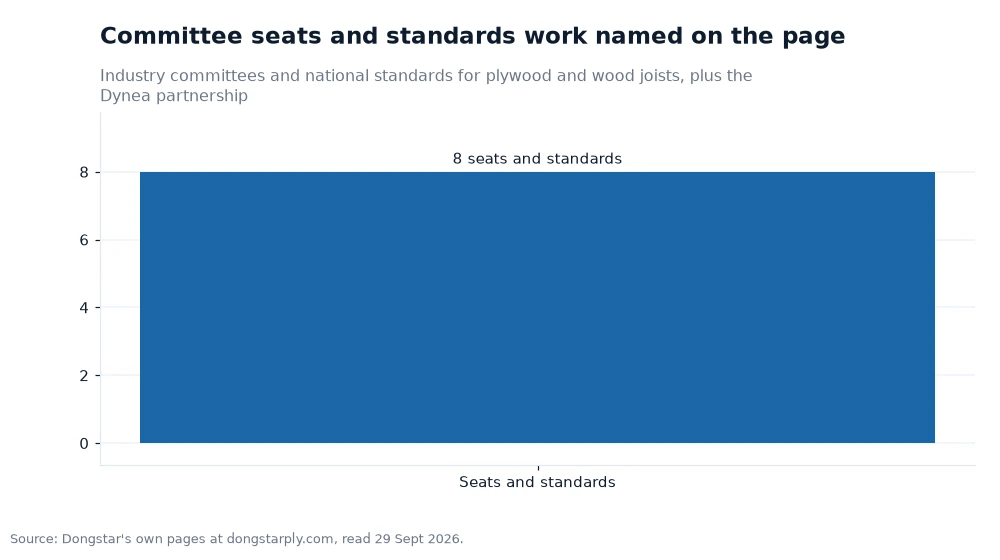
The chart on this page records eight seats and standards. The page's own list can be grouped without double counting to reach that figure: three associations, three national standards, one technical committee seat and one standards platform give 3 + 3 + 1 + 1 = 8 (example arithmetic). The Dynea partnership is a supply relationship rather than a seat and is counted separately. Grouping the list this way is what stops a questionnaire from counting the same membership twice under two different names.
A second count is worth running when standards work is used as a shortlisting filter. If a buyer shortlists five suppliers and requires each to name at least three relevant roles or standards, the target across the shortlist is 5 × 3 = 15 named items (example). One page here supplies 8 of them. The follow-up question is not whether the number is large, but which of those 8 touch the product being ordered: formwork standards are relevant to a shuttering buyer and irrelevant to a buyer specifying melamine-faced boards for wardrobes.
Frequently asked questions
Which committees does the group list?
Its pages name the China Shuttering Board Committee, the China Formwork and Scaffold Association and the China Africa Economy Trade Investment Promotion Association, along with a seat on the National Technical Committee on Wood-Based Panels and a founding role in the China Shuttering Board Industry Platform.
Which national standards does the group say it helped draft?
The National Standard of Plywood for Concrete Form, the National Standard of Wood-joist for Building Structures and the National Standard of Plywood Dimension are all named on the company pages, alongside work on wood-based panel standardisation.
Does committee work replace product certification?
No. A drafting role shows involvement in how a standard is written; it is not evidence that a specific board has been tested against it. Ask for the certificate or inspection report that applies to the exact product being ordered.
Turning standards work into a shortlist
Two product pages show what the standards work is attached to: the structural three-ply sheet, sold against formwork requirements, and the formwork beam range, which sits close to the wood-joist standard quoted above. Reading a committee list beside those specifications is how an importer separates a real specialisation from a long associations page.
The committee roles, national standards and supplier partnership described in this article are listed on the supplier's own site, checked on 29 Sept 2026, and taken for these notes[1].