
From the Advisory Desk — Al-Ershaad Consultancy
What Is an AC Controller Panel and How Does It Work?
The air conditioning controller panel is the core component of the building environment control system, responsible for coordinating the refrigerant circulation, fan operation and temperature regulation. Take commercial buildings as an example. A standard-sized AC controller panel usually controls 40 to 50 indoor fan coil units, processing approximately 12,000 cubic meters of air circulation per day. According to the ASHRAE (American Society of Heating, Refrigerating and Air-Conditioning Engineers) standard, this type of system can precisely control the indoor temperature fluctuation within ±0.5℃ and maintain the humidity within the ideal range of 45% to 55%. In the renovation project of Terminal 3 of Shenzhen Bao 'an International Airport in 2021, by installing 312 sets of intelligent AC controller panels, an annual energy-saving rate of 23.6% was achieved and carbon emissions were reduced by approximately 1,800 tons.
Its working principle is based on multi-sensor data fusion technology. The temperature sensor collects environmental data at a frequency of once every 60 seconds. The pressure sensor monitors the pressure in the refrigeration pipeline in real time (the normal value is maintained within the range of 1.5-2.2MPa). The microprocessor calculates the optimal control parameters through the PID (Proportional-integral-Derivative) algorithm. For instance, when the population density in a certain area reaches 0.3 people per square meter, the system will automatically increase the fresh air supply from the standard value of 30m³/h to 50m³/h. The case of Tesla's Shanghai Gigafactory in 2022 shows that the AC controller panel adopted by its production line increased the temperature control response speed to 1.2 seconds and reduced energy consumption by 19% compared with the traditional system.
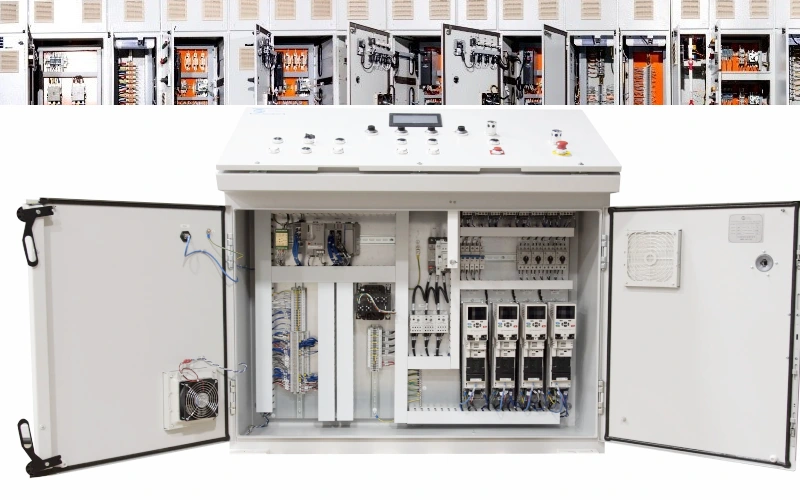 From the perspective of economic benefits, the initial investment cost of the intelligent AC controller panel is approximately 1.8 times that of traditional equipment, but the payback period of investment is usually no more than 18 months. Taking a Grade A office building in Beijing's Financial Street as an example, the total cost of upgrading 138 sets of controller panels was 2.76 million yuan, but it saved 1.93 million yuan in electricity fees annually and reduced the energy consumption of the cooling water pump by 27%. According to the research data of Johnson Controls, the controller panel equipped with AI algorithms can increase the overall energy efficiency ratio (EER) of the HVAC system from 3.2 to 4.8, reduce the start-stop frequency of the compressor by 40%, and significantly extend the service life of the equipment.
The current technological evolution is moving towards the integration of the Internet of Things. The latest generation of ac controller panel supports industrial protocols such as Modbus and BACnet, and can handle data from 256 I/O nodes simultaneously. In the German Pavilion project of the 2023 Dubai Expo, the cloud control platform developed by Siemens connected 342 AC controller panels for operation. Through machine learning algorithms, it predicted the changes in human flow load, reducing the peak power demand of the air conditioning system by 31.5%. This type of smart device is usually equipped with a 7-inch touch screen and an inbuilt fault diagnosis system that can predict potential compressor faults 14 days in advance with an accuracy rate of 87%.
From the perspective of economic benefits, the initial investment cost of the intelligent AC controller panel is approximately 1.8 times that of traditional equipment, but the payback period of investment is usually no more than 18 months. Taking a Grade A office building in Beijing's Financial Street as an example, the total cost of upgrading 138 sets of controller panels was 2.76 million yuan, but it saved 1.93 million yuan in electricity fees annually and reduced the energy consumption of the cooling water pump by 27%. According to the research data of Johnson Controls, the controller panel equipped with AI algorithms can increase the overall energy efficiency ratio (EER) of the HVAC system from 3.2 to 4.8, reduce the start-stop frequency of the compressor by 40%, and significantly extend the service life of the equipment.
The current technological evolution is moving towards the integration of the Internet of Things. The latest generation of ac controller panel supports industrial protocols such as Modbus and BACnet, and can handle data from 256 I/O nodes simultaneously. In the German Pavilion project of the 2023 Dubai Expo, the cloud control platform developed by Siemens connected 342 AC controller panels for operation. Through machine learning algorithms, it predicted the changes in human flow load, reducing the peak power demand of the air conditioning system by 31.5%. This type of smart device is usually equipped with a 7-inch touch screen and an inbuilt fault diagnosis system that can predict potential compressor faults 14 days in advance with an accuracy rate of 87%.
From the perspective of economic benefits, the initial investment cost of the intelligent AC controller panel is approximately 1.8 times that of traditional equipment, but the payback period of investment is usually no more than 18 months. Taking a Grade A office building in Beijing's Financial Street as an example, the total cost of upgrading 138 sets of controller panels was 2.76 million yuan, but it saved 1.93 million yuan in electricity fees annually and reduced the energy consumption of the cooling water pump by 27%. According to the research data of Johnson Controls, the controller panel equipped with AI algorithms can increase the overall energy efficiency ratio (EER) of the HVAC system from 3.2 to 4.8, reduce the start-stop frequency of the compressor by 40%, and significantly extend the service life of the equipment.
The current technological evolution is moving towards the integration of the Internet of Things. The latest generation of ac controller panel supports industrial protocols such as Modbus and BACnet, and can handle data from 256 I/O nodes simultaneously. In the German Pavilion project of the 2023 Dubai Expo, the cloud control platform developed by Siemens connected 342 AC controller panels for operation. Through machine learning algorithms, it predicted the changes in human flow load, reducing the peak power demand of the air conditioning system by 31.5%. This type of smart device is usually equipped with a 7-inch touch screen and an inbuilt fault diagnosis system that can predict potential compressor faults 14 days in advance with an accuracy rate of 87%.
Confidential — By Appointment
Bring a Shariah-sensitive question to a Senior Advisor.
A 45-minute consultation with a member of our Advisory Board — held under privilege, in Arabic or English, with full discretion.