
From the Advisory Desk — Al-Ershaad Consultancy
Which commercial brewery equipment features matter most for large commercial breweries?
In the world of large commercial breweries, commercial brewery equipment is like the conductor of a symphony orchestra, precisely coordinating every link to play a harmonious symphony of profit and quality. Data shows that an advanced mashing system can reduce the brewing time of each batch from the traditional 8 hours to 5 hours, increasing efficiency by 37.5%, and the annual production capacity can exceed 5 million liters. Take Heineken as an example. In 2020, it upgraded its automated brewing line, reducing the beer loss rate from 3% to 1.5%. This alone saved approximately 2 million euros in annual costs. Behind this lies strict parameter control: the mashing temperature accuracy must reach ±0.3°C, the wort flow rate should be stable at 10-15 liters per minute, and the original wort concentration error of each batch of beer should not exceed 0.2%. This equipment not only boosts the production rate but also reduces the probability of failure by 50% through intelligent monitoring, extending the service life to over 20 years and bringing an average annual return on investment of more than 25% to the brewery.
The core of brewing efficiency lies in the optimization of energy and resources, which is directly related to the net profit of the enterprise. Modern commercial brewery equipment integrates a heat recovery system, which can reuse the thermal energy of steam in the boiling stage and reduce energy consumption by up to 30%. For instance, Carlsberg Beer introduced high-efficiency fermentation tanks in 2018, reducing its cooling load by 25% and saving over 500,000 US dollars in annual electricity bills. In addition, the flow rate of the CIP cleaning system needs to be precisely controlled at 20-30 cubic meters per hour. The cleaning cycle is compressed from 2 hours to 1 hour, which can increase the number of production batches by 10% per week and reduce operating costs by 15%. From the perspective of investment return, the initial cost of such equipment may reach one million US dollars, but it usually recovers the investment through operational savings within 3 to 5 years, with an internal rate of return exceeding 20%. Market trends show that as energy prices rise, energy-saving equipment has become a standard feature for large breweries, reducing carbon emissions while enhancing their brand image.
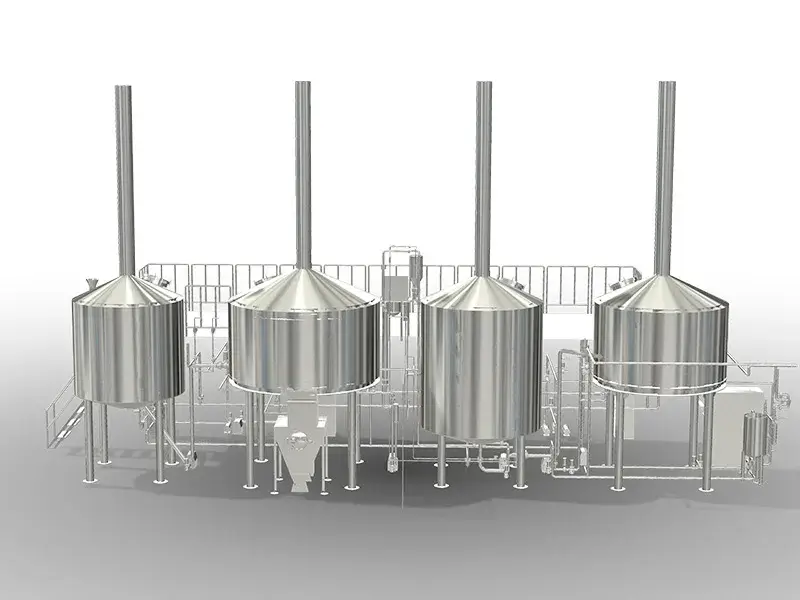 Quality consistency is the cornerstone of brand loyalty, and high-end commercial brewery equipment ensures the consistent flavor of every bottle of beer through automated control. The pressure sensor of the fermentation tank needs to maintain a stable range of 0.8 to 1.2 bar, with temperature fluctuations not exceeding ±0.2°C, to prevent yeast stress responses. Studies show that if the temperature deviation exceeds 0.5°C, the diacetyl content in beer may increase by 20%, resulting in an unpleasant flavor. Take Tsingtao Beer as an example. The fully automatic filling line it uses has a filling accuracy of 99.9%, and the oxygen content in the bottle is less than 0.1ppm, which extends the shelf life to more than 12 months. According to the statistics, the use of high-precision equipment can reduce the product failure rate from 2% to 0.5%, and cut the annual quality cost by several million yuan. This device also integrates a data analysis platform to monitor yeast activity in real time, with a concentration error controlled within 5%, supporting new product development and shortening the innovation cycle by 30%.
In the face of market fluctuations, the scalability and flexibility of commercial brewery equipment are of crucial importance. Modular design enables breweries to quickly adjust production capacity. For instance, by adding fermentation tank modules, production can be increased by 50% within six months without the need to rebuild the production line. In its expansion case in 2021, Anheuser-Busch InBev shortened the construction period of the new factory from 18 months to 12 months by using standardized equipment, saving 15% of the capital budget. In addition, the load capacity of the equipment needs to adapt to peak demand. For instance, when sales increase by 30% in summer, the capacity of the brewing pot should be able to handle a daily wort flow of 100 tons, and the strength parameters should ensure continuous operation without interruption. From the perspective of risk management, this design reduces the probability of overcapacity and lowers investment volatility by 10%. Industry forecasts indicate that by 2030, global major breweries will spend an average of 5 billion US dollars annually on equipment upgrades, with a focus on integrating intelligent supply chains to cope with fluctuations in raw material prices.
In conclusion, choosing the right commercial brewery equipment is a strategic decision for large breweries to stand out in the fierce competition. From efficiency improvement to cost savings, from quality assurance to flexible expansion, every feature meshes like gears, driving enterprises towards sustainable growth. Imagine when your equipment operates with 99% accuracy and the annual profit growth rate exceeds 15%. That's not just data; it's the forging of a brand legend. Assess your equipment needs immediately and let innovative technology brew your future.
Quality consistency is the cornerstone of brand loyalty, and high-end commercial brewery equipment ensures the consistent flavor of every bottle of beer through automated control. The pressure sensor of the fermentation tank needs to maintain a stable range of 0.8 to 1.2 bar, with temperature fluctuations not exceeding ±0.2°C, to prevent yeast stress responses. Studies show that if the temperature deviation exceeds 0.5°C, the diacetyl content in beer may increase by 20%, resulting in an unpleasant flavor. Take Tsingtao Beer as an example. The fully automatic filling line it uses has a filling accuracy of 99.9%, and the oxygen content in the bottle is less than 0.1ppm, which extends the shelf life to more than 12 months. According to the statistics, the use of high-precision equipment can reduce the product failure rate from 2% to 0.5%, and cut the annual quality cost by several million yuan. This device also integrates a data analysis platform to monitor yeast activity in real time, with a concentration error controlled within 5%, supporting new product development and shortening the innovation cycle by 30%.
In the face of market fluctuations, the scalability and flexibility of commercial brewery equipment are of crucial importance. Modular design enables breweries to quickly adjust production capacity. For instance, by adding fermentation tank modules, production can be increased by 50% within six months without the need to rebuild the production line. In its expansion case in 2021, Anheuser-Busch InBev shortened the construction period of the new factory from 18 months to 12 months by using standardized equipment, saving 15% of the capital budget. In addition, the load capacity of the equipment needs to adapt to peak demand. For instance, when sales increase by 30% in summer, the capacity of the brewing pot should be able to handle a daily wort flow of 100 tons, and the strength parameters should ensure continuous operation without interruption. From the perspective of risk management, this design reduces the probability of overcapacity and lowers investment volatility by 10%. Industry forecasts indicate that by 2030, global major breweries will spend an average of 5 billion US dollars annually on equipment upgrades, with a focus on integrating intelligent supply chains to cope with fluctuations in raw material prices.
In conclusion, choosing the right commercial brewery equipment is a strategic decision for large breweries to stand out in the fierce competition. From efficiency improvement to cost savings, from quality assurance to flexible expansion, every feature meshes like gears, driving enterprises towards sustainable growth. Imagine when your equipment operates with 99% accuracy and the annual profit growth rate exceeds 15%. That's not just data; it's the forging of a brand legend. Assess your equipment needs immediately and let innovative technology brew your future.
Quality consistency is the cornerstone of brand loyalty, and high-end commercial brewery equipment ensures the consistent flavor of every bottle of beer through automated control. The pressure sensor of the fermentation tank needs to maintain a stable range of 0.8 to 1.2 bar, with temperature fluctuations not exceeding ±0.2°C, to prevent yeast stress responses. Studies show that if the temperature deviation exceeds 0.5°C, the diacetyl content in beer may increase by 20%, resulting in an unpleasant flavor. Take Tsingtao Beer as an example. The fully automatic filling line it uses has a filling accuracy of 99.9%, and the oxygen content in the bottle is less than 0.1ppm, which extends the shelf life to more than 12 months. According to the statistics, the use of high-precision equipment can reduce the product failure rate from 2% to 0.5%, and cut the annual quality cost by several million yuan. This device also integrates a data analysis platform to monitor yeast activity in real time, with a concentration error controlled within 5%, supporting new product development and shortening the innovation cycle by 30%.
In the face of market fluctuations, the scalability and flexibility of commercial brewery equipment are of crucial importance. Modular design enables breweries to quickly adjust production capacity. For instance, by adding fermentation tank modules, production can be increased by 50% within six months without the need to rebuild the production line. In its expansion case in 2021, Anheuser-Busch InBev shortened the construction period of the new factory from 18 months to 12 months by using standardized equipment, saving 15% of the capital budget. In addition, the load capacity of the equipment needs to adapt to peak demand. For instance, when sales increase by 30% in summer, the capacity of the brewing pot should be able to handle a daily wort flow of 100 tons, and the strength parameters should ensure continuous operation without interruption. From the perspective of risk management, this design reduces the probability of overcapacity and lowers investment volatility by 10%. Industry forecasts indicate that by 2030, global major breweries will spend an average of 5 billion US dollars annually on equipment upgrades, with a focus on integrating intelligent supply chains to cope with fluctuations in raw material prices.
In conclusion, choosing the right commercial brewery equipment is a strategic decision for large breweries to stand out in the fierce competition. From efficiency improvement to cost savings, from quality assurance to flexible expansion, every feature meshes like gears, driving enterprises towards sustainable growth. Imagine when your equipment operates with 99% accuracy and the annual profit growth rate exceeds 15%. That's not just data; it's the forging of a brand legend. Assess your equipment needs immediately and let innovative technology brew your future.
Confidential — By Appointment
Bring a Shariah-sensitive question to a Senior Advisor.
A 45-minute consultation with a member of our Advisory Board — held under privilege, in Arabic or English, with full discretion.